I have enjoyed blogging through The Phaith of St. Phransus and sharing and cultivating theological ideas with friends and fellow bloggers.
I have decided that I need to take some space away from blogging for a season and spend my time studying, and reflecting where God is leading me.
I may come back to blogging after I had some time away, but it probably won't be as The Phraith of St. Phransus. We'll just have to see about that one.
Thanks for wonderful wonderful discussions, challenges, and most of all friendships (which I value more than ever).
shalom,
Jonathon Norman
Tuesday, May 29, 2007


Wednesday, May 23, 2007
GREAT NIGHT TONIGHT

I just got home from wed. night youth activities and am winding down. Tonight we had a coffee house/benefit concert to raise awareness and funds for Darfur relief. IT WENT GREAT!! What was my favorite part?
Fav Part 1: It had to be that the band who performed is one of my favs right now- The Psalters. They lead a large youth crowd in singing the apostle's creed, part of the communion liturgy, and ended with their great rendetion of the Lord's Prayer. All of this great music set to their tribal/gypsy/punk rock affinity.
Fav Part 2: my youth group did such a wonderful job at being hosts tonight. I saw my kids step up and show wonderful hospitality to both a very humble group of artists and musicians and to the guests who came to the coffee house. WAY TO GO Y'ALL!!
Fav Part 3: Brian McLaren came!! Well, not really for the show, but he was there. He is in town for the Festival Of Homiletics and I along with Team JV will be assisting him in the morning with "Emerging Worship" so Team JV met to go over the worship gathering.
Fav Part 4: Red Hands!!
Pics will come later after Gavo sends them to me and I will post. I will leave with this quote from the newest Psalters CD, "The Divine Liturgy of the Wretched Exiles" which I picked up tonight:
oh it is true that songs can do what bombs have always missed?
to strike the lips of power that all meen have longed to kiss
to strike the lips of power that all meen have longed to kiss
that all may know if You don't save than everything is lost
Your road map to freedom is from infancy to cross
no rock will bear my load, i'll cry out loud with in my time
a battle cry against this world
"God help me!" is the line
"God help me!" is the line
and as i rush upon the field i know i may fall slain
but i would rather fight and die than live my life in vain
THOUGHTS ON WAR....
great article by William Cavanaugh:
History does not tend to be kind to Christian theologians who demand war.
Peter Steinfels recently called attention to a contemporary history lesson drawn in an ongoing debate between Catholic neo-cons who have supported the Iraq war and the popes and bishops who have not (“A Catholic Debate Mounts on the Meaning of ‘Just War,’” The New York Times, April 14). In the April issue of First Things, George Weigel revisits his arguments for the justice and necessity of the Iraq war and refuses to admit regret. Weigel instead casts blame for the failures in Iraq in two directions: the U.S. foreign policy community who failed adequately to plan for the war’s aftermath, and the Arab Islamic political culture whose “irresponsibility, authoritarian brutality, rage and self-delusion” has caused them to refuse “the foreigner’s gift” of political freedom that we have brought them. (I’m not making that up.)
The history lesson is delivered in a commentary by the editors in Commonweal (“Bishops and Their Critics,” April 20), who remind their readers of Weigel’s original well-publicized arguments in favor of the invasion back in 2003. They focus on one key point: In the face of vociferous objections to the impending war by the pope and the U.S. bishops, Weigel argued that Catholics should defer to the president’s judgment on whether or not this war, or any war, met the just war criteria.
Weigel’s argument on this point was two-fold: 1) the president has access to privileged information, and 2) the president, by virtue of his office, exercises a “charism of political discernment” not shared by leaders of the church. The Commonweal editorial wonders whether all the mistakes that Weigel points to in his recent article undermine his claim of the special charism enjoyed by the president. Commonweal remarks that, in retrospect, the Catholic bishops’ charism in matters of war and peace looks pretty darn good compared to that of the president.
Weigel’s argument here is self-defeating. In the case of the Iraq war, the more he insists on point number one, then the more point two is proven false. If the president did indeed have access to privileged information, then he either misinterpreted that information or deliberately lied about it to make a case for the war. This conclusion seems inescapable, given what we now know about how pre-war intelligence was handled.
Regardless of the facts of this particular case, moral judgments about war, like all moral judgments, are not primarily a matter of good information. Good information is a necessary, but not sufficient, condition for sound moral judgments. Sound moral judgments depend on being formed in certain virtues. Why a Christian should assume that the president of a secular nation-state would be so formed – much less enjoy a certain “charism” of moral judgment – is a mystery to me. “Charism” is a theological term denoting a gift of the Holy Spirit. To apply such a term to whomever the electoral process of a secular nation-state happens to cough up does not strike me as theologically sound or practically wise.
The fundamental issue here is of much greater importance than arguments about the justice (or lack thereof) of this particular war. Weigel would have the church effectively abdicate its moral judgment in matters of war to the leaders of the nation-state. It is hard to imagine what could do greater damage to both church and nation. If the church does not have an independent process of discernment to bring the gospel to bear on matters of war and peace, then any hope that the Prince of Peace will be heard over the din of self-interest and fear will be lost. History is already littered with the wreckage caused by Christian capitulation to reasons of state.
William Cavanaugh is associate professor of theology at the University of St. Thomas in St. Paul, Minnesota, and author of Theopolitical Imagination and Torture and Eucharist.
History does not tend to be kind to Christian theologians who demand war.
Peter Steinfels recently called attention to a contemporary history lesson drawn in an ongoing debate between Catholic neo-cons who have supported the Iraq war and the popes and bishops who have not (“A Catholic Debate Mounts on the Meaning of ‘Just War,’” The New York Times, April 14). In the April issue of First Things, George Weigel revisits his arguments for the justice and necessity of the Iraq war and refuses to admit regret. Weigel instead casts blame for the failures in Iraq in two directions: the U.S. foreign policy community who failed adequately to plan for the war’s aftermath, and the Arab Islamic political culture whose “irresponsibility, authoritarian brutality, rage and self-delusion” has caused them to refuse “the foreigner’s gift” of political freedom that we have brought them. (I’m not making that up.)
The history lesson is delivered in a commentary by the editors in Commonweal (“Bishops and Their Critics,” April 20), who remind their readers of Weigel’s original well-publicized arguments in favor of the invasion back in 2003. They focus on one key point: In the face of vociferous objections to the impending war by the pope and the U.S. bishops, Weigel argued that Catholics should defer to the president’s judgment on whether or not this war, or any war, met the just war criteria.
Weigel’s argument on this point was two-fold: 1) the president has access to privileged information, and 2) the president, by virtue of his office, exercises a “charism of political discernment” not shared by leaders of the church. The Commonweal editorial wonders whether all the mistakes that Weigel points to in his recent article undermine his claim of the special charism enjoyed by the president. Commonweal remarks that, in retrospect, the Catholic bishops’ charism in matters of war and peace looks pretty darn good compared to that of the president.
Weigel’s argument here is self-defeating. In the case of the Iraq war, the more he insists on point number one, then the more point two is proven false. If the president did indeed have access to privileged information, then he either misinterpreted that information or deliberately lied about it to make a case for the war. This conclusion seems inescapable, given what we now know about how pre-war intelligence was handled.
Regardless of the facts of this particular case, moral judgments about war, like all moral judgments, are not primarily a matter of good information. Good information is a necessary, but not sufficient, condition for sound moral judgments. Sound moral judgments depend on being formed in certain virtues. Why a Christian should assume that the president of a secular nation-state would be so formed – much less enjoy a certain “charism” of moral judgment – is a mystery to me. “Charism” is a theological term denoting a gift of the Holy Spirit. To apply such a term to whomever the electoral process of a secular nation-state happens to cough up does not strike me as theologically sound or practically wise.
The fundamental issue here is of much greater importance than arguments about the justice (or lack thereof) of this particular war. Weigel would have the church effectively abdicate its moral judgment in matters of war to the leaders of the nation-state. It is hard to imagine what could do greater damage to both church and nation. If the church does not have an independent process of discernment to bring the gospel to bear on matters of war and peace, then any hope that the Prince of Peace will be heard over the din of self-interest and fear will be lost. History is already littered with the wreckage caused by Christian capitulation to reasons of state.
William Cavanaugh is associate professor of theology at the University of St. Thomas in St. Paul, Minnesota, and author of Theopolitical Imagination and Torture and Eucharist.
Sunday, May 13, 2007
Friday, May 11, 2007
SPIRIT FALL ON ME... Pentecost and Worship
Here are a couple of worship ideas to use for Pentecost Sunday (not my ideas).
1. Some churches use Pentecost Sunday (like my church) as a confirmation day
2. Like confirmation Pentecost Sunday is also a traditionally popular day for baptisms (it makes sense doesn't it?).
3. Use the day to celebrate all the ministries of the church and all the lay people who share in those ministries.
4. Invite everyone to wear the color Red (liturgical color for Pentecost)
Besides those worship ideas I put together this pentecost worship slide show. I came up with the song last night and then put together the slides from various pictures portraying pentecost, flames or wind. Enjoy:
1. Some churches use Pentecost Sunday (like my church) as a confirmation day
2. Like confirmation Pentecost Sunday is also a traditionally popular day for baptisms (it makes sense doesn't it?).
3. Use the day to celebrate all the ministries of the church and all the lay people who share in those ministries.
4. Invite everyone to wear the color Red (liturgical color for Pentecost)
Besides those worship ideas I put together this pentecost worship slide show. I came up with the song last night and then put together the slides from various pictures portraying pentecost, flames or wind. Enjoy:
Worship video loop for Pentecost Sunday that I did. Enjoy.
THE MONK-O-MERGENT CHALLENGE
So my good buddy Stephen, aka Rev. Fife, spent a week being very emergent at monk-ee at a monastery in Cajun Territory. His last words as he recapped the experience was a CHALLENGE... TO ME!!


He said... BEAT THAT JONATHON!!
Well obviously, being one who is up for a challenge I sought out to do just that. The following story is TRUE:
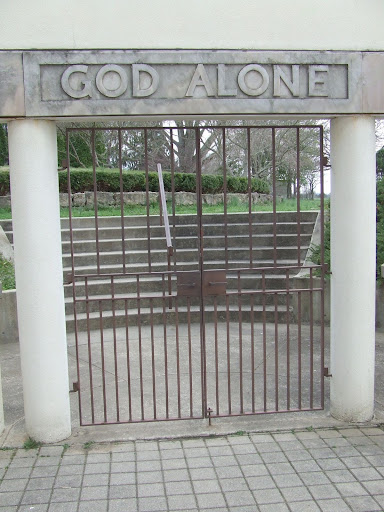
I arrived early in the morning... dew was still on the ground, there was even still a chill in the air, even though the sun had been out for at least two hours. As I pulled into the entrance of the Monastery I saw the gate that said "God Alone" just like I had so many times before. I felt a little uneasy about this visit BUT a challenge is a challenge and I did not know any other way to answer THE CALL.
There was some stirring in the community at this point, monks heading off to do their daily work. As I walked around the campus a few greeted me with smiles, but none stopping to talk- it was off to various jobs. And I had mine to do anyway.
It would not be easy to infiltrate into the hermit's hermitage. In speaking with a couple of the brothers in the past I knew that his cottage was off limits. He had been back there for years, keeping his vow of silence and praying for the world. Like the monastic hermits before him- he stood in a tradition of prayer and solitude that only few people would choose to live.
Upon my last trip to the Abbey at Gethsemani I had picked up a map of the grounds and knew exactly where I needed to go. It would not be easy though- around a lake, behind a walled and secure area and not to mention "monks gone wild" if they were to see me. But I had plotted the entire mission out. I was not leaving until I had outdone Stephen Fife. Oh he is so smug with his Brian McLaren book while being in the presence of monks in compline. "I will show him", I thought to myself.
But the first part of my adventure that morning was to conjure some good mojo. I walked one of the trails into a quiet area where there where only a few statues and some trees. There off to the side was my friend... my patron saint... my brother- St Francis. There I said morning prayer- Francis and Phransus- it was perfect almost like when all the robot cats would come together to create Voltron.

Then it was time. I put on my black monastic habit with ninja facial wrap and nonchucks and headed down a winding path. After several hours I finially made it to a small cottage. It was beautiful how I crept around the cottage- there was no way anyone could hear or see me- I was a model of STEALTH.

I peeked into the window and there was what appeared to be an old man. His beard was grey and long, his hair unkept. He was washing dishes and appeared to be in his own little world. I hid in a bush and part 1 of my plan began. I had some stones in my pocket that I had picked up along the way and I began throwing them at the door. The door slung open and the hermit peered out... NOTHING... He went back in.

Oh I laughed to myself, this is just too easy. Again I did the same thing. And again the hermit peered out... NOTHING... He went back in.
The third time I moved closer to the cottage, then threw the rocks just as before. This time when the door swung open and the hermit peered out I snuck in behind him into the house (i moved like the speed of light). I positioned myself under his bed. I waited there all day. He went on with his "hermit tasks", mostly prayer and then cleaning, and prayer and writing.
It was time. I came out from under the bed. The old hermit was now carving a large walking stick. On the end he was carving what looked like St. Benedict. I was a little fearful that he might know how to use this as a weapon, but I had made it this far and there was no way Stephen was going to outdo me as the king of monk-o-mergentism.
I jumped on top of his bed and yelled!! The hermit froze and then jumped head to the ceiling and yelled out a profanity that I cannot repeat here!!
He came down from the ceiling... I laughed... he just kept screaming swear words at me....
I got silent.... he continued... and continued.... and continued.... until.... he... finally... got.... quiet.... he looked at me.... I looked at him....
I made my way to the door and left him with this advice.... "SHHHH... IT HAPPENS".
BEAT THAT STEPHEN!
Shalom,
stPhransus
ME BASED BIBLE STUDY
SWEET!!! A new Bible Study based on ME!!! You'll definitely want to pick it up for your next small group B.S.
Thursday, May 10, 2007
SPIRIT FALL ON ME...

I have not been blogging too much lately which is understandable. Wearing the "youth pastor cap" I have a crazy busy summer coming up and still lots to get done before hand... wearing the "daddy cap" I have felt the urgency of wanting to do some extra stuff with Jonas and Abby before summer hits- for instance tonight we went to our neighborhood library for "night time stories and lullabyes along with milk and cookies" which was really nice (especially the cookies and milk. Of course the "hubby cap" has almost been worn now for 11 years (15 more days) and with summer approaching I am wanting to be present more. And obviously the caps go on and on....
Besides the caps that I wear I have several books I'd like to get through- such as one that I'm really enjoying that is on the philosophy/theology of Alasdair MacIntyre.
But one of the projects going on right now that I'm really enjoying is preparing electronica/ambient tracks for an emerging style worship gathering led by Brian McLaren and some fellow bloggers. It will be during the Festival of Homiletics and Brian will be preaching this particular service. I will be acting as the monastic dj- spitting out crazy ambient soundtrack music along with gavo as the monastic vj- giving visual ambience to the sounds. It should be pretty cool.
So here is a worship track I put together not for the emerging worship event, but just for... whatever. It is for the first sunday of pentecost.
Feel free to download it:
Ad Pedes Spiritus (Spirit Fall To Our Feet)
Lyrics:
"Spirit- fall on me; Spirit fall on me"
What is Pentecost?
Tuesday, May 08, 2007

"CERTIFIED CANDIDATE YOU ARE..."

Last Thursday I met with our Jedi Council, the Nashville District Committee on Ordained Ministry. As of Thursday I am now a certified candidate. It was a very good meeting (much better than the meeting in the fall).
So now I am waiting to be in touch with my DS to see if I will be able to be appointed to Hermitage UMC (my current church where I am on staff as the youth and young adult pastor) as a licensed local pastor with responsibilities for Youth and Young Adults.
Also another update- I spoke with the admissions department at Sewanee School of Theology about the possibility of transferring from Trevecca. Sewanee is an episcopal divinity school. My main reason for wanting to transfer is that they offer a Masters of Divinity degree and are recognized by the United Methodist University Senate. Also, I think that Sewanee would be a great fit for me. Lots to do before Annual Conference!
Thursday, May 03, 2007
PLAY
Gavo and I are heading to Beersheba Springs to lead worship for our TN Conference Youth Ministry Institute.
One of the worship stations that I am envisioning is a space that deals with Youth Groups and how we play together as a spiritual practice.
Here's a track that I just finished up to have at the station.
One of the worship stations that I am envisioning is a space that deals with Youth Groups and how we play together as a spiritual practice.
Here's a track that I just finished up to have at the station.
Monday, April 30, 2007
DR. ROBERT WEBBER, 1933-2007

A dear hero of mine passed away this weekend. Dr. Robert Webber was a teacher, a writer, and creative voice within the Church. His ideas on worship and evangelism has been a wonderful gift and inspiration to me over the last several years as I have struggled through my own faith journey.
He is probably most known for his "ancient future" series of books. Its funny because he gets thrown into the "emergent" crowd a lot of times. Several years ago Gavin and I had a chance to hook up and talk to Dr. Webber while at an emergent convention. I was being my obnoxious self and going around and asking different emergent leaders if they could spell out the ecclesiology of emergent (be careful, i ask that of methodists too). It was my biggest criticism of emergent at the time. So I asked the question of Dr. Webber. And he laughed and said- "you know, I don't know what it is either! And that's probably the place where I part ways with emergent. What I'm trying to do is more convergent movement. I'm here teaching but I don't really get what this is all about."
We had a laugh over that and I realized what a wonderful, brilliant and quirky gift Dr. Webber was to the Church. Thank you Dr. Webber for what you contributed to the Christian faith of the 21st century.
you can read a reflection here from the chaplain of the worship institute of which Dr. Webber was a vital part.
Thursday, April 26, 2007
A WEEK WITH... THE PSALTERS day 4

Scott on struggles and victories:
"I work at Covenant House which is a shelter for runaway teenagers. Working with the homeless and learning from them and what they have to say about life has taught me a lot. The struggles of dealing with ghetto people and that whole mentality--because I don't have that mentality--living among them, that has been quite a struggle. That's been an exodus from my upper middle-class upbringing and my comfy-cozy life that I've been blessed to have. Then going into Philly and living there and hanging out with heroin addicts, people who are constantly manipulating you because that's the only way they can live, hearing gunshots in the middle of the night. The struggles of that have really helped me with my music and with my spiritual life and that's the key; the best place for art is also the best place for your spiritual life and that's amidst exodus.
I believe in this fallen world we are to be pilgrims. God created order out of chaos and he moved over the surface of waters and then there was light. I think that's kind of how art is. You go through the struggle and then you create out of what you experience from that struggle and there's that movement from pain to struggle to joy, it's that constant cycle. It's that cycle that we need to stay in, for art and for our spiritual life. So many of us Christians have such crappy art because we don't seem to be willing to struggle as much as we should. It's the same problem with America in general."
Listen to song: Turn Me 'Round
Wednesday, April 25, 2007
A WEEK WITH... THE PSALTERS day3

Scott speaking on the original psalters from Old Testament times:
"They created their music amidst exodus and it was exodus with faith. They did not fixate in pain and sorrow and just stay there and not see hope. And they didn't stay comfortable and stagnant in praise and joy and pastels. They were in movement, they were in pilgrimage, they were going through the depths of the sea, and the wilderness and the desert. Their music had that passion and struggle in it.
In order to go into exodus you have to have faith. You have to have trust that God will deliver you. And if you read throughout the Psalms, there's this crazy lamentation, and it's honest and it's truthful. When they were in pain they admitted it and they talked about it and they struggled with it. They didn't ignore it. They said, "My God, my God, why have you forsaken me?" But then, even in the midst of that struggle, while they were right in it, they would cry out in faith and say, "Praise you God." So I characterize it as a constant movement; struggle for righteousness with great faith."
Listen to song: The Lord's Prayer
Tuesday, April 24, 2007
CELEBRATING RESURRECTION....
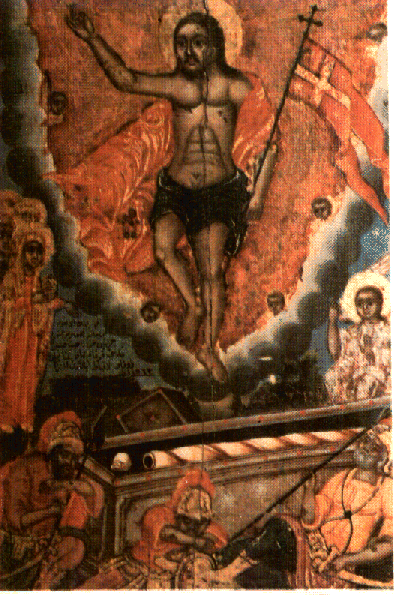
There might be a temptation to view Easter as only one Sunday. It's sort of like we go through this intense season of Lent and then Holy Week things get REALLY intense. And finially Easter Sunday comes and then we take a breath and say, "shooo, it's over. another wonderful holy season."
But I would suggest that it's way more beneficial to the worship life of our communities that we observe the full Easter season that the Church has recognized for centuries. According to The New Handbook of the Christian Year, the Easter season also known as The Great 50 Days is “the greatest, most festive season of the Christian Year." But it doesn't always seem that way.
In her article, "What's So Great About the Great 50 Days", Erin Martin, suggests that "Maybe it’s because this “great” season begins in the doldrums of “Low Sunday,” the term used to describe the sparsely populated pews the week after the Easter crowd has gone home. Maybe it’s because as “flabby” Christians we arrive at the season already exhausted from the preceding Lenten demand of 40 days of discipline."
In Blair Gilmer Meeks book, Season of Ash and Fire: Prayers and Liturgies for Lent and Easter, she offers some refreshing suggestions for revitalizing the Great 50 Days. First, she points out that the number fifty calls to mind the year of the Jubilee from Leviticus 25, a time appointed to replenish the earth, free the slaves, cancel debts and spread God’s justice and peace throughout the land. Consequently, the season following Easter is for us a “Jubilee of days,” a time for rejoicing in the restoration we receive through the death and resurrection of Jesus Christ. The Great 50 Days is an occasion each year for the people of God to announce anew a time of God’s favor.
Also, Meeks explains that the Lectionary readings for the Great 50 Days are never a mere reiteration of the Easter narrative, but rather, they are a progression that flows forward from the narrative. In the eight Sundays that follow, the readings disclose more and more about the resurrected Lord and the God who sent him. As a result, the Easter story doesn’t get stale. Instead it gradually leads us into deeper insight into the risen Jesus and into the community of faith that will be left behind. By reliving the stories of resurrection through the lectionary we find ourselves moving with the disciples right into Pentecost.
But I would suggest that it's way more beneficial to the worship life of our communities that we observe the full Easter season that the Church has recognized for centuries. According to The New Handbook of the Christian Year, the Easter season also known as The Great 50 Days is “the greatest, most festive season of the Christian Year." But it doesn't always seem that way.
In her article, "What's So Great About the Great 50 Days", Erin Martin, suggests that "Maybe it’s because this “great” season begins in the doldrums of “Low Sunday,” the term used to describe the sparsely populated pews the week after the Easter crowd has gone home. Maybe it’s because as “flabby” Christians we arrive at the season already exhausted from the preceding Lenten demand of 40 days of discipline."
In Blair Gilmer Meeks book, Season of Ash and Fire: Prayers and Liturgies for Lent and Easter, she offers some refreshing suggestions for revitalizing the Great 50 Days. First, she points out that the number fifty calls to mind the year of the Jubilee from Leviticus 25, a time appointed to replenish the earth, free the slaves, cancel debts and spread God’s justice and peace throughout the land. Consequently, the season following Easter is for us a “Jubilee of days,” a time for rejoicing in the restoration we receive through the death and resurrection of Jesus Christ. The Great 50 Days is an occasion each year for the people of God to announce anew a time of God’s favor.
Also, Meeks explains that the Lectionary readings for the Great 50 Days are never a mere reiteration of the Easter narrative, but rather, they are a progression that flows forward from the narrative. In the eight Sundays that follow, the readings disclose more and more about the resurrected Lord and the God who sent him. As a result, the Easter story doesn’t get stale. Instead it gradually leads us into deeper insight into the risen Jesus and into the community of faith that will be left behind. By reliving the stories of resurrection through the lectionary we find ourselves moving with the disciples right into Pentecost.
A WEEK WITH... THE PSALTERS day2

Scott on why "The Psalters"...
"I read in a couple of books somewhere that the people who performed the Psalms back in David's time were called "psalters." They were people who praised God through music. What I wanted to do is glorify God through music and I wanted to do it in the way that they did it, not with the same sound or the same style or with the same rituals, but with the same philosophy, the same heart, and the same passion.
That was back in '93. Back then I couldn't play anything. I was talking to Karin Bergquist of Over the Rhine and I said, "I'm too old to start music." She encouraged me to go with it, and said, "When you make it, give me a call." Ever since I wanted to be in music, it was always the psalters project. The name is an identity, not a band name."
listen to song: Hosanna
Monday, April 23, 2007
A WEEK WITH... THE PSALTERS day1

If you happen to be in the Nashville area either May 22 or 23 you definitely should not miss The Psalters. These self proclaimed nomads travel around in their big black bus and share there creativity with anyone willing to listen- blending VERY organic world music with the ancient liturgies and creeds of the Church. If I had to put them into a category it would be something like- gypsy punk meets radical orthodoxy.
I am excited about both nights because on the 22nd they will be in East Nashville at The 5 Spot performing (which is my neighborhood) and on Wed. the 23rd they will be performing for our youth group's first coffee house night which is also a benefit show to raise awareness and support for the Darfur region. Our show starts at 6pm, no cover, just donations (half to darfur and half to our travelling gypsies).
So with that shared, I have decided to spend my next "week with" series with The Psalters, words from band member Scott Krueger and music clips from the band. Enjoy.
May the Lord bless you and keep you,
stPhransus
Subscribe to:
Posts (Atom)