Saturday, August 27, 2005

TALES OF THE VIOLENT PACIFIST 5


OK SO THIS IS NOT GOING THE WAY I PLANNED...
MAYBE THIS IS WHY I'M A PACIFIST.... WOW, COLE JUST KICKED MY BUM!!!
I guess I'll lick my wounds and get the heck out of dodge!!!
Cole, you won the battle but not the war!!! YO JOE!!!!

Friday, August 26, 2005

GUESS WHAT'S UNDER JOHN'S PILLOW?


John, you little devil... nightee night!!!

A WEEK WITH HAUERWAS, day 5


Hauerwas on violence and America:

To offer concrete alternatives means you have to be different. We love violence. When was the last time you went to see a movie about peace? I mean, we're attracted to violence. It's dramatic. It gives us a moral, heroic role! You've got to be really embedded in a different set of practices to force a different imagination.

Thursday, August 25, 2005

THE "PRO-LIFE" DISCONNECT

EVANGELICAL (מטיף בקנאות לעיקרון מסוים): of or pertaining to or in keeping with the Christian gospel especially as in the first 4 books of the New Testament.

I consider myself an evangelical, in the best sense of the word. I am very passionate about my relationship with Jesus Christ and strive to practice my faith in the most authentic way that I can. I also really want to see people become whole and fulfilled in their lives. I do believe that the most truthful expression of being made whole is through realizing God's grace in one's life, seeing that grace manifested through Jesus and participating in the lifestyle of the Christ community (THE CHURCH).

I have to make a confession- I am a church geek. I love worship, and spiritual practices, church history, liturgy, conservative christians and liberal christians, the Bible, and trying to follow the teachings of Jesus.

Geez I even like to read the Rule of Saint Benedict, stories about the saints, Jewish folklore, and stories about the circuit riders.

But as much as I love the church I can't keep my big mouth shut when something is on my mind. I just finished reading a post over at Shane's site about abortion. And it made me think again how many of our churches are disconnected.

Take for instance the socio-political stance of being "PRO-LIFE". In Shane's post he quotes fellow blogger, LaShawn Barber, who says,
"If the mere possibility that innocent babies are tortured in the womb doesn’t make these women want to hang their heads in shame for advocating murder… but they’ll realize one day soon how depraved they are. It’s too tragic for words."

I think this is a wonderful quote and I stand behind it completely. But what it has brought to mind is that we don't seem to stand behind the same reasoning when it comes to...

The Death Penalty, or War...

If LaShawn's statement were completely prolife it might go something like this:
"If the mere possibility that innocent people sitting on death row might be killed via the death penalty doesn't make the state hang it's head in shame for advocating state sanctioned murder... but they'll realize one day soon how depraved they are. It's too tragic for words."

or

"If the mere possibility that Christians killing innocent children, women and bystanders in Iraq doesn't make the Church hang it's head in shame for advocating war... but they'll realize one day soon how depraved they are. It's too tragic for words."

1. I understand that most will disagree with me on this. That's ok. I'm used to it. But I do invite discussion and dialog- BUT ONLY IF YOU REALLY THINK ABOUT THE IMPLICATIONS OF TAKING A "PRO-LIFE" STANCE FIRST.

2. When I speak of war and the killing of innocents- I am strictly speaking of Christians killing other people. I realize that war is a reality in our world- that nations war against one another. But if we take seriously that Christians "practice" an alternative lifestyle that is founded upon following the way of Jesus- then it seems to me that this should dictate the kinds of activities we do and don't do. I'm not sure that participation in war is something a Christian ought to do.

shalom
jn

A WEEK WITH HAUERWAS, day 4


Hauerwas on spirituality and disciplines

I gave up on the language of spirituality because the assholes got it. Spirituality became a way to talk about a universal need that we all have that can be expressed through any religion some way or the other. This kind of individualistic, getting-myself-right with the powers of the world, I’m not sympathetic toward it. I am very sympathetic toward exercises that have been well explored through centuries of Christian practice that are now embodied in wise people that can teach you how to go on. But, never forget, the Devil’s a spirit and the Devil can appear as a spirit of discernment, and so you have to be very careful with that. I wouldn’t want to be among the proponents of spirituality today. I’m more than willing, though, to talk about prayer, fasting, obedience, silence. I regard spirituality as learning how to talk. What that means is not being afraid of your “first order” religious convictions, and that you can just say it. The Psalms are “first order” religious convictions, so I take a lot of comfort from the Psalms.

Day 3

Day 2

Day 1

Wednesday, August 24, 2005

THE WORLD'S BEST BLOG POST

In an effort to bring about world peace, Gavin and I have collaborated to bring you the world's best post. Check it out.

A WEEK WITH HAUERWAS, day 3


Hauerwas on marriage

When couples come to ministers to talk about their marriage ceremonies, ministers think it's interesting to ask if they love one another. What a stupid question! How would they know? A Christian marriage isn't about whether you're in love. Christian marriage is giving you the practice of fidelity over a lifetime in which you can look back upon the marriage and call it love. It is a hard discipline over many years.

Tuesday, August 23, 2005

"Kindness Killed the Texan" A.K.A . "Which One Would Get a Butt Whuppin' If They Fought"


gavin richardson said...
"i think stan needs to do a battle of violent/nonviolent theologies with pat robertson"

alright- who'd gonna win in the great battle of faith? Will it be Stanley The Cussin Texan Hauerwas, or Pat "Killem' With Kindness.... Or Anything Else But Just Killem" Robertson?

You decide....

Watch Hauerwas here.
Watch Robertson here.

cast your vote in the comment section

A WEEK WITH HAUERWAS, day 2


Hauerwas on Sept. 11:

Christian willingness to kill other Christians in the name of national loyalty is surely one of the assumptions many Christians assume is not to be questioned. Yet no assumption has contributed more to the accommodation of Christianity to secular ways of life than the presumption that Christians have no problem with war. For Christians to be nonviolent is not just another political position, but rather at the very heart of what it means to be Christian, of what it means to be human. I believe God created all that is with the desire to be nonviolent. We are not meant to be killers. That is why we have to be trained to kill. God wants us to be in love with God and with one another in a manner that our differences challenge our self-imposed desires. Christians in America have difficulty responding to September 11 as Christians because we are more American than we are Christian.

HONESTY BUILT THE BRIDGE


Chuck Colson has written a great article where he realizes that no secular agenda held by either liberals or conservatives "get it right". In my eyes this kind of truthfulness and insight, if adopted by UM's would pave some bridges in dialog and even new and different possibilities. Check the article, "What is Justice: neither liberals or conservatives have it quite right".

Monday, August 22, 2005

Accountable Discipleship Blog


We have a new United Methodist blogger in the bl'ouse (blog-house)!!!! Check out Steve Manskar's blog- Accountable Discipleship.

Steve is the author of "Accountable Discipleship, Living In God's Household", 'Perfect Love: Understanding John Wesley's "A Plain Account of Christian Perfection'" and is also the Director of Accountable Discipleship for the General Board of Discipleship, Nashville, TN.

Look for good thoughts and posts at Accountable Discipleship.

Steve, welcome to the neighborhood.

A WEEK WITH HAUERWAS, day 1


Hauerwas on Violence And The Church:

God's given us all the time we need to patiently help our congregations be what they can be. That's the way you want people formed, because that's the way the Spirit operates. If you help people discover the violence in their lives, though, don't expect to be honored. One of my favorite epigrams is that Christians are not nonviolent because we believe our nonviolence is a strategy to rid the world of war, even though, of course, we want to make the world less violent. But rather, Christians are nonviolent in a world of war because we cannot image anything else as faithful followers of Christ.

HERE COME THE POMOGS!


Friday, August 19, 2005

Don't Cry For Me


WORDS FROM THE DESERT
(sayings of the desert fathers)

'A brother questioned Abba Poemen in this way, 'My thoughts trouble me, making me put my sins aside, and concern myself with my brother's faults'. The oldman told him the following story about Abba Dioscorus (the monk), 'In his cell he wept over himself, while his disciple was sitting in another cell. When the latter came to see the old man he asked him, "Father, why are you weeping?" "I am weeping over my sins," the old man answered him. Then his disciple said,"You do not have any sins, Father." The old man replied, "Truly, my child, if I were allowed to see my sins, three or four men would not be enough to weep for them. " '

I like the desert fathers because they don't mince words and they have such a simple way of living in community together. But perhaps when you're living in caves and very rustic conditions in an area where the land does not make survival easy- then simple structures and simple ways of life together is of great importance.

I wonder what our church might look like if we had more Abba Dioscorus's, unable to focus on the sins of others, concerning themselves with their own shortcomings. It's so difficult to get to a place where I can say, "I have faults, and I sin." However when I do this along with my brothers and sisters in my congregation then I begin to see the "other" person as no better or worse than I- simply a child of God in need of God's grace and my love, and I needing the same from them.

The world can feel like the desert a lot of times- the conditions can be hard and difficult. Unfortuanately the church a lot of times feels no different than the world. There are people inside who seem like the anonymous brother who concerns his or herself with the sins of others, and having troubling thoughts- which usually causes others to have troubling thoughts.

Maybe we need pastors, youth pastors, lay leaders, and prophets who will be our Abba Poemans- telling stories from the desert, and a place where we are called to confess OUR OWN sins, and embrace those who come to us seeking shelter.

jn

Thursday, August 18, 2005

Hope Beyond All Hope


"During the darkest periods of history, quite often a small number of men and women, scattered throughout the world, have been able to reverse the course of historical evolutions. This was only possible because they hoped beyond all hope. What had been bound for disintegration then entered into the current of a new dynamism."

- the late Brother Roger, founder of the Taize Community

THERE'S A DISCONNECT IN OUR CHURCH

Romans 12: 1-2, 4-6
Place Your Life Before God 1So here's what I want you to do, God helping you: Take your everyday, ordinary life--your sleeping, eating, going-to-work, and walking-around life--and place it before God as an offering. Embracing what God does for you is the best thing you can do for him. 2Don't become so well-adjusted to your culture that you fit into it without even thinking. Instead, fix your attention on God. You'll be changed from the inside out. Readily recognize what he wants from you, and quickly respond to it. Unlike the culture around you, always dragging you down to its level of immaturity, God brings the best out of you, develops well-formed maturity in you.


4In this way we are like the various parts of a human body. Each part gets its meaning from the body as a whole, not the other way around. 5The body we're talking about is Christ's body of chosen people. Each of us finds our meaning and function as a part of his body. But as a chopped-off finger or cut-off toe we wouldn't amount to much, would we? So since we find ourselves fashioned into all these excellently formed and marvelously functioning parts in Christ's body, 6let's just go ahead and be what we were made to be, without enviously or pridefully comparing ourselves with each other, or trying to be something we aren't.


"We know that 30,000 children die each day due to preventable illness and malnutrition - that means a child dies somewhere in the world every three seconds; almost 11 million children die every year. To put that in perspective, that's nearly the number of people that live in Ohio or Michigan." - Adam Taylor in Sojourner Magazine

I am the first to admit that I like a good heated debate/conversation when it comes to theology and doctrinal issues (especially as they relate to the United Methodist Church).

But as I read the above quote today it became very apparent to me just how disconnected our doctrine and theology is. We argue over the issue of homosexuality because we read that the Bible says that it is wrong. But for the 4-5 times that it condemns homosexuality, how many more times does it condemn the affluent and powerful overlooking the needs of the poor and helpless? THERE'S NO COMPARISON.

There's a disconnect in the church today (actually it has been there all along), but we say we want to be inclusive or embracing but yet we continue to create walls of division in the name of being holy, being scriptural and docrinal. It strikes me as sad that Jesus came not for the religious to know God but that the left out, forgotten, and unacceptables might experience community and wholeness.

If we're going to take serious that some people should not be included in the full life of the church, because of what the Bible says, then I think we'll have to exclude anyone who is not seriously working to eradicate poverty. Are you challenging your churches to have a voice in this? Are you pressuring your government, your commander and chief to make wise decisions? Are you striving to live simply and below your means that you might SHARE with those who have none (which is VERY Wesleyan)?

There's a disconnect in the church today. It seems that most of us doing the talking about being holy, and living scripturally, holding keys to the kingdom of who's in and who's not- who receives and who doesn't are people that by societal and global standards wield power. How are we going to use the power and priveledge that we have? Will we help live out God's vision of shalom or will we miss the kingdom all together?

I'm afraid that in a lot of ways- we're missing the kingdom all together. It has taken artists and musicians outside the church to get our country to becoome aware of the scale of global poverty that we're dealing with in the world. It has taken the artists, activists and musicians outside the church to help bring our country on board to "make poverty history".

All the while the church is more concerned with issues of abortion and homosexuality than 30,000 children dying every day. There's a disconnect in the church.

"O holy and merciful God,
we confess that we have not always taken upon ourselves
the yoke of obedience,
nor been willing to seek and to do your perfect will.
We have not loved you
with our whole heart and mind and soul and strength,
neither have we loved our neighbor as ourselves.
You have called to us in the need of our brothers and sisters,
and we have passed unheeding on our way.
In the pride of our hearts, and our unwillingness to repent,
we have turned away from the cross of Christ,
and have grieved your Holy Spirit."
- Wesleyan Methodist Conference, England, 20th Cent.


Taize Religious Community Founder Slain Founder of a Christian ecumenical community stabbed to death at an evening prayer service.
Associated Press August 17, TAIZE, France

Brother Roger, the 90-year-old founder of an ecumenical religious community dedicated to peace and reconciliation, was knifed to death by a woman at an evening prayer service attended by 2,500 people, authorities said.

The slaying was deplored Wednesday by the pope and the head of the Anglican Church, who called the slain monk "one of the best-loved Christian leaders of our time."
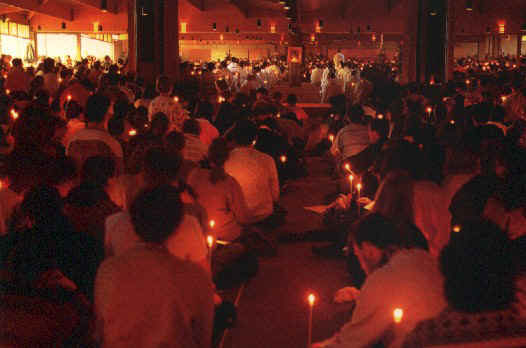
An all-night prayer vigil was held following the fatal attack Tuesday night in the church at Taize, in Burgundy.

A Romanian woman wielding a knife killed silver-haired Brother Roger, witnesses said. A community spokesman, Brother Emile, said the monk's throat was cut and he died 15 minutes later.

Taize officials said the woman had arrived two days earlier among thousands of pilgrims who visit the site. Prosecutor Jean-Louis Coste said the woman, reportedly 36 years old, had bought the knife the day before.

"It would appear for now there is little doubt that this was premeditated since she bought a knife the day before and voluntary homicide is manifest," Coste told reporters without naming the woman.

Coste said the woman detained for questioning by police. He said she was not "unbalanced enough to justify psychiatric care."
People at the service grabbed the woman, who had sprung from the crowd, and turned her over to police.

Brother Roger founded the Taize religious community in 1940 emphasizing the need for all Christians to come together in peace, love and reconciliation. The Taize ecumenical community, which is near Macon, 240 miles southeast of Paris, draws tens of thousands of Christian youths from around the world each year for prayer and meditation.

Pope Benedict XVI said he had received a "very moving and very friendly letter" just Tuesday from Brother Roger. Benedict spoke of the "very sad and terrifying news."
"This is an indescribable shock," said Archbishop of Canterbury Rowan Williams, spiritual leader of the Church of England. "Brother Roger was one of the best-loved Christian leaders of our time and hundreds of thousands will be feeling his loss very personally, and remembering him in prayer and gratitude."

President Jacques Chirac praised Brother Roger as "one of the most remarkable servants of the values of respect and tolerance," while German Chancellor Gerhard Schroeder said he regarded Brother Roger as one of the "great contemporary personalities of religious life."
Schroeder praised him for sheltering Jewish refugees during World War II and later fostering reconciliation in Europe.

Copyright 2005 Associated Press. All rights reserved. This material may not be published, broadcast, rewritten, or redistributed. (oh well, i did it anyway)

Wednesday, August 17, 2005

I AM A LIL' BIT MONASTIC BUT SO ARE YOU


I received an interesting email from a new friend- "Oblate X", whom although posted a comment somewhere on my blog, I cannot seem to find where he posted.

His comment is a reference to where I must be describing myself as a "little bit monastic". His comment says, "I'm not sure you can be a "little bit monastic" - that is sort of like being a "little bit married". Marriage and monasticism are both defined by the nature of the vow. The monastic vow (in the Benedictine tradition anyway) is to poverty, stability, and conversion. The key to these is stability - the lifelong commitment (much like a marraige vow). Without this vow, and the renunciation of private ownership, it is impossible to experience monastic life, just as it is impossible to experience marriage by sleeping with women you've known for only a week. It's worth thinking about - monasticism can't be "had" in a week's time."

My thoughts on this:
I agree with you to an extent. Yes monasticism is a vow to a "way of life". Yes that way of life is a dedication to living a lifestyle of poverty, stability and conversion. This commitment is a lifel0ng commitment and "process" of sanctification through observing the specific practices of monasticism.

Where I disagree is that one has the option of being called to cloistered life as a benedictine or a secular ordered benedictine. Obviously one cannot give up privite property in doing a secular order, however one can observe the rule, practice the rule, pray for brothers and sisters, and live out (in spirit) the ideals of the benedictine way. My understanding of possessions is that they are not privite property but that we are stewards of God's gifts. So as far as I'm concerned there is really no such thing as private property.

When I say that I'm a little bit monastic what I mean by that is not that I'm casually committed, but that I try to live out the ideal of the benedictine spirit.

I would be careful in the way you approach your critique because you sound a bit like some of my fundamentalist friends, who at times can be quite pharisaicle. Oblate X- I look forward to further conversations.

shalom,
jonathon

The Passing of Brother Roger


Brother Roger has entered the life of eternity. This has come as a shock to me, as I know it has to everyone else. Brother Roger started the Taize Community in Taize France back in the 1940's and has been an incredible witness to both the peace and love of Christ ever since.

During the evening prayer on Tuesday 16 August, in the midst of the crowd surrounding the Community in the Church of Reconciliation, a woman - probably mentally disturbed - struck Brother Roger violently with knife blows. He died a few moments later.

In its sorrow, the Taizé Community thanks all those who are supporting it by their affection and their prayer. On the morning of 17 August, after Brother Roger's death, the following prayer was read in the church:

"Christ of compassion, you enable us to be in communion with those who have gone before us, and who can remain so close to us. We confide into your hands our Brother Roger. He already contemplates the invisible. In his footsteps, you are preparing us to welcome a radiance of your brightness."

The funeral of Brother Roger will take place on Tuesday 23 August at 14.00.

Each afternoon, from 15.00 to 19.00, his body is placed in the church of Taizé, so that all who wish may go and meditate close by him.

Eight years ago, Brother Roger designated Brother Alois to succeed him, as the person in charge of the community. Brother Alois has entered straightaway into his ministry as servant of communion at the heart of the community.

Let us keep the brothers of Taize along with the many young pilgrims who are deeply saddened by this in our prayers this week.

Worship Feast's Worship Music


It looks like I'll be working on creating songs for Abingdon Press' upcoming Worship Feast project- "Worship Feast: Prayer Stations". It will be an interactive DVD with prayer stations developed by Gavin, along with contemplative music to use during the worship around the stations.


So Brandon Brooks and myself (aka Treefinger) will be creating the very hynpotic grooves that you will hear on the project- much fun and quite meaningful I hope. I think it'll be out by next spring. You can check out one of the upcoming tracks, "On This Rock", at the Treefinger site by clicking here.

Friday, August 12, 2005

A Great Ending to the "Not So" Sabbath Adventures


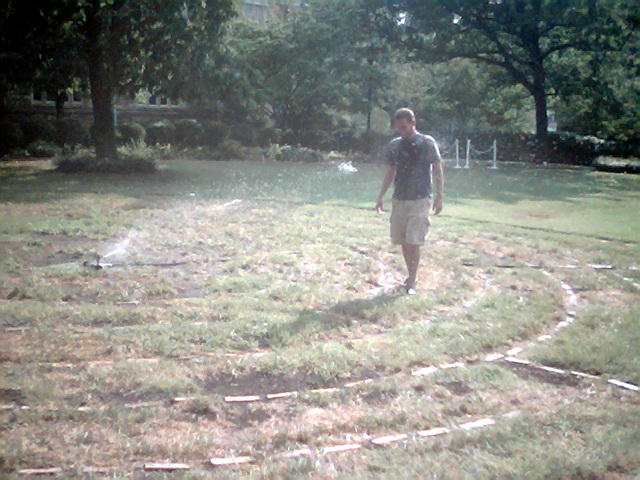
The day was winding down. Gavin and I were walking to our cars to call our "Not So" Sabbath Day quits when I spotted the labyrinth at Scarritt-Bennett.
Finally- the opportunity for silence and solitude. I began walking and I felt something- it was amazing. Wow, this silence stuff really works. Then I realized- the sprinklers around the labyrinth had come on. On a day when the heat index was close to 100, and humidy was 1000%, the water from the sprinkler became the living water of Christ for me.... not a bad way to finish a Sabbath Day Retreat.

shalom all,
jonathon

Rock Star Religion


How well do you know the spiritual lives of the gods of rock? I apparently do not know as much as I thought. You can click here to see how much YOU know.

The "Not So" Sabbath Day Adventures of Gavo and Jonathon

Picture yourself in the halcyon days of childhood. You are putting on your jacket, getting ready to leave home, when your mother calls out your name.

"Where are you going?" she asks.

"Out," you say.

"With whom?" she continues.

"My friends," you answer.

"To do what?" she inquires.

"Nothing," you say....

That is the scenario for the last two days of my life. Yesterday Gavin and I had decided would be a Sabbath Day. First we were going to go to Penuel Ridge for an overnight time of solitude. Well, after several meetings quickly took over as the agenda for the day for both of us- that got shot down.

After the last meeting at the United Methodist Publishing House was over (more about that later) we decided to carry over the idea of a Sabbath Day.

So today I woke up early ,went into church to get some things done for the weekend,and then decided to see if Gavo and I could use Stillpoint as our Sabbath Day homebase. My buddy Sis. Kathleen (another story for another blogpost) informed me that becuase of various projects going on at Stillpoint a sabbath would not be a good experience there.

So then I went to the next best location- Bill Lizor's office. I thought to myself- "self, what a very tranquil place Bill Lizor's office might be." But instead I found a very pissy Bill Lizor on Friday (poor bill). He was just in a real blah mood. None of my lame and annoying jokes lifted his spirits.

So then finially Gavo, Bill and I hooked up for lunch and then Gavin and I went over to Vanderbilt Divinity Scool in search of a wifi connection to surf and have quiet. What we found was a nice lounge but no wifi. So instead we went up to the Vandy Div School Cokesbury bookstore (yes vandy has a cokesbury located in the div school). There we harassed Dan and Angela as they were busy stocking shelves full of wonderful and intriguing works of theology.


(Dan at Cokesbury enjoying stock day)


Frustrated at our lackage of wifiness we have no settled down for the last part of our Sabbath Day back at the Alektor Cafe (sometimes i feel like i live here). And here I am writing this post and lauging at John "Liberace" Wesley and listening to monks chant. Wow, Sabbath Days with Jon and Gavo- a lot of holy (or not so holy) laughter and just a lil' bit of solitude.

Sunday, August 07, 2005

A Great Weekend in the Mountains


I just got in a few hours ago from a great weekend at Beersheba Springs Assembly, our TN Conference Retreat center. I took the youth group to Summer Sizzler, the conference's big summer youth event.

We had the largest number of youth attending this event ever. What a great weekend. Now I'm absolutely pooped.

Every year this event means for me the summer is coming to a close. Wow, it seems as though it just started. Oh well, I guess it's time to start thinking about Advent....

More to come this week.

Tuesday, August 02, 2005

THE MEANS OF GRACE- WHAT'S THAT MEAN?


So last week I wrote a post about how frustrated I get sometimes with the polarization that I see in the church today. Not that I think we can easily move passed this nor do I think the issues over which we debate and discuss are trivial enough that we ought to dismiss them.
I did conclude however that what ought to be at the center of Methodist polity- ought to be a denomination that embodies "practices" of faith.

"Practicing our faith" was so central to John Wesley's idea of how we do church together that he instituted practices as central to the Methodist societies- he called them the "means of grace". Means of Grace as defined by Wesley were nothing more than practices that Christians were to engage in that over time with much practice- would help a person to continually become more and more like Jesus.

According to Richard Foster- these spiritual practices (means of grace) are made up of:
THE INWARD DISCIPLINES
Meditation, Prayer, Fasting, Study
THE OUTWARD DISCIPLINES
simplicity, Solitude, Submission, Service

THE CORPORATE DISCIPLINES
Confession, Worship, Celebration, Sacraments

Steven Harper, director of Spiritual Formation at Asbury Seminary says this about spiritual practices:
" We are made in the image of God, and as Augustine said, our hearts are restless until they rest in God. To live the life of a disciple is to live the life we have always wanted to live. When we live as disciples, our hearts exclaim, 'For this I was made!' And out of that exclamation will come a willingness to practice the spiritual disciplines in whatever ways will make us better followers of the Master."
This kind of thinking had a huge impact on Wesley- the more we practice a spiritual discipline, the more the practice becomes a way of life.
So back to Methodists and the Means of Grace. I have an idea and I want to see if anyone is interested in trying this with me.
Henry Knight III is the Donald and Pearl Wright Professor of Wesleyan Studies at St. Paul School of Theology. He has written a book called, "Eight Life Enriching Practices for United Methodists". According to a writeup on the General Board of Discipleship's website: "Eight Life-Enriching Practices of United Methodists presents the basic practices of Christian discipleship. Also known as the means of grace and spiritual disciplines, these eight practices are the historic places where God promises to meet God's people face to face. They are an essential part of the life of Christian discipleship because they are how disciples grow in faith, hope, and love."
So I'm interested in seeing if there is a group of people that would be willing to read this book- maybe 1 chapter per week, focussing on living out the practice during the week and posting about it on their blog. What we'd in effect have are various ways that different Methodist Christians begin to strive to live out their faith with a shared/common language but we'd each live out those practices in different expressions.
I'm thinking that it would start at the beginning of September and we'd go till we get through the book. There's a few other great books on Wesley and spiritual practices that we could do if this goes well- including Paul Chilcoates- Recapturing The Wesley's Vision, and fellow blogger, Ken Carter's- A Way of Life in the World.
So, who's in?

Thursday, July 28, 2005

The Archbishop of Canterbury Tells... Us What's Up


Rowan Williams is a theologian. Rowan Williams is an Anglican Christian. He is the Archbishop of Canterbury. And he is quite possibly one of the strongest and most creative voices that we have in the Church today.

Check out a sermon of his that he preached at medieval St. Mary's Church in Nottingham June 26, 2005, before the G8 Summit.

Monday, July 25, 2005

USING OUR MORAL IMAGINATIONS FOR MORAL ALTERNATIVES


One of the problems that I have with the whole liberal-conservative political arguments is that there is often times a failure to use our imaginations to solve problems. We resort to rhetoric and argument.

I admit that I am not special or unique to this. My moral and political imagination is flabby and needs to be exercised too. When I spoke up and said that I was against our going to war in Iraq a few years ago I was often asked what alternative I would propose. I never had a good response for creative alternatives. But I knew that the alternatives are out there. The problem that I see is that individual alternatives don't really matter- it'll take communities rooted in certain practices and traditions to offer the alternatives and then live them out.

So what might an alternative look like? Maybe its really really small. Maybe the alternatives are varied and many. I read an article today. It began like this:

"July 25 - An Islamic organization has launched a national campaign that proposes an expansion of Muslim youth in scouting as one way to combat terrorist ideology, violence and extremism within the American Muslim community."

I wonder if our leaders looked for more imaginative and creative alternatives to WAR on Terror what might happen. I wonder if we could plant these kinds of seeds all over the world? There have to be folks all over the world throughout all the world's relgions that could be inspired to plant seeds such as this.

read U.S. Islamic Group Launches Campaign to Combat Home-Grown Terrorism in its entirety here.

Practice planting seeds this week and pray for good fruit.

shalom,
jonathon

Weekly Reflections from Abby


So here's a great new addition to my regular posts- weekly reflections from my 9 month old daughter, Abby.

She may only be 9 months old, but she has some wonderful ideas about life. So here we go, this week's thought:

"vbbgh n..esa1 tvhujkn,kjk lh rgrh vgj fdvxc gfv7"

BRILLIANT if I do say so myself.

PETRA BECOMES PETRA-FIED

Hot off the press- after years together, shaping the way of CCM, Petra is calling it quits...


did I miss something?

I didn't know these guys were even still alive let alone still a band... ummm, until today.

I suppose this means we can expect to see them on a reality show at some point kickin' it up with the ole' songs and auditioning for a new singer or something like that... We'll just have to wait and see, won't we.

Sunday, July 24, 2005

CHURCH GROWTH MOVEMENTS AND PRACTICAL ATHEISM


These words of UM Bishop Kenneth L. Carder (one of my heroes and aquaintances) may be pertinent in the discussion of the practices and place of the Church Growth Movement and the United Methodist Church.


"When the consumerist motivation becomes pervasive everything is reduced to a utilitarian market commodity. Worship is reduced to a marketing tool to attract the masses and is shaped by personal preferences and individual tastes. Evangelism is seen more as joining the church than a radical reorintation of life in response to prevenient, justifying, santifying, and perfecting grace. Ministry becomes a commodity to be dispensed by the professionals and received by the laity. Institutional participation is equated with discipleship and mission is treated as an optional object of occasional financial support. The church is viewed as another of the many institutions competing for the loyalty and support of people, who shop for the institution that best fulfils their self-identified needs.

The loss of the centrality of theology moves God to the periphery of the church's life or makes God a utilitarian commodity. Thus, some have charged The United Methodist Church in the United States with "atheism". Contemporary Methodists tend to trust planning processes, organizational strategies, institutional structures, and the insights gleaned from the social sciences more than the power of gospel proclaimed and lived. Without firm theological grounding and critique, as Wesley practiced in the eighteenth century, the methods employed by the church promote a practical atheism under the guise of the Christian faith. The church loses its memory and relies on the surrounding culture to give it identity and purpose."

written by Bishop Kenneth L. Carder (former bishop for TN Conference); excerpt from Rethinking Wesley's Theology For Contemporary Methodism; edited by Randy Maddox

Saturday, July 23, 2005

A New/Old Kind of Church Discipline


The Protestant reformers named three "marks by which the true church is known": the preaching of the pure doctrine of the gospel, the pure administration of the sacraments, and the exercise of church discipline to correct faults. Today, church discipline is feared as the mark of a false church, bringing to mind images of witch trials, scarlet letters, public humiliations, and damning excommunications. Does discipline itself need correction and redemption in order to be readmitted into the body of Christ?

This excerpt from Christianity Today caught my attention this morning. Among my evangelical friends I know that the idea of church discipline and accountability is an important issue. The last line of the excerpt asks the question- "Does discipline itself need correction and redemption in order to be readmitted into the body of Christ?

It seems to me that church discipline tends to be reduced to "beliefs" about how church is church- which adheres to a more modern or rationalistic way of looking at discipline.

If mainline protestants who want to remain faithful to the reformational spirit and don't want to lose one of our hallmarks- church discipline- then how do we view it in a postmodern, or transition from modernity, context?

I think we have to go back to the orthodox church- before the great schism and see how they viewd church discipline. Orthodox Chrisitanity held practice/mysticism and belief/rationalism in balance with one another. In fact both were connected, a part of one another. This ideas of both right belief and practice is missing in the church today. Part of the fault of modernity has not been it's technological breakthroughs, it's dedication to science and enlightenment thought. The fault is it's failure to prepare us for Postmodernity.

Going back to Orthodoxy means that we embrace rationalism along with the ancient practices of the church. So we ask ourselves what are life enriching practices that have sustained the church and might continue to sustain the church in the coming days?

Dorothy Bass in her book, Practicing Our Faith gives us historic practices put in a modern context that might help shape Christian communities:
1. Honoring the Body
2. Hospitality
3. Household Economics
4. Saying Yes and Saying No
5. Keeping Sabbath
6. Testimony
7. Discernment
8. Shaping Communities
9. Forgiveness
10. Healing
11. Dying Well
12. Singing Our Lives

I think a shift in the way we view church discipline- a shift that goes back to the premodern church in order to inform the postmodern church- might just help us get past the doctrinal conflict that we can't seem to move passed. I don't know that these specific practices are all THE practices for a new way of viewing church discipline but it's a start. I wonder what our Annual Conferences would look like if there was an emphasis on practicing prayer together and committing to our churches practicing our faith in such a new way?

Friday, July 22, 2005

SoulFeast and the Day After


I haven't posted this week because I was part of the leadership staff for SOULfeast, a spiritual formation conference for families hosted by Upper Room, held at Lake Junaluska. I had a terrific time. I was part of the youth ministry team. My role was to lead a pilgrimage into Ashville, NC with the youth and then lead a couple of the youth sessions.

So on Tue. we went on a pilgrimage into Ashville and split the youth into 3 groups. Each group was given a disposable camera and given the task of finding God in the ordinary places of life and take a picture of that.

On Wed. we talked about Jacob travelling on pilgrimage and how at a very ordinary place he experienced the presence of God and gave that place a new name- Bethel.

On Thur. we ended the youth time with a contemplative worship experience with various prayer stations. All in all it was a wonderful week.

A few personal blessings came out of the week for me:
1. Jen, Jonas and Abby got to come along and be a part of the week. It was great for once to lead an event and my family be there too.

2. The highlight spiritually for me was walking the labyrinth, an ancient form of praying using a circular path, at Lake Junaluska and introducing it to my 3 year old son. Together we walked it and when we got the middle we sat together and he said the Lord's Prayer. It was a beautiful moment for me. In fact after we walked it he wanted to do it again. So the second time we walked it Jen and Abby came too.

3. I found time some much needed quiet time.

Upon returning I decided that today I'd walk the labyrinth here in town at Scarritt Bennitt. Once again it became a wonderful and quiet moment for me to bring some concerns that I'm having before God. I think I'll do it more often- hopefully once a week.

And I'm gonna try and take Jonas with me at least once a month. My friend Kara Oliver was also one of the youth leaders at SOULfeast. Check out her blog to read her reflections on SOULfeast.

Tuesday, July 19, 2005

Will the real Slim Jonathon Please Stand Up?

My BFF, Gavin, interviewed me. We have way too much time on our hands.

Check out the interview here.


But is this the real Jonathon?

John, over at Locust and Honey also interviewd me for his Blogger Profile. Check his out here and I'll let you draw your own conclusions.

Saturday, July 16, 2005

BLOG WITHOUT WORDS


Our being is silent, but our existence is noisy.
--Thomas Merton

We bloggers enjoy our words. I wonder though if we take enough time out when we're not writing to practice the spiritual discipline of "silence and holy listening". I know that my words can quickly become hurtful and condemning when I'm not rooted in God's compassion. Taking time out to simply "be" in God's presence through the practice of silence brings me back to God's love and helps me connect with that.

In her article about a personal experience of practicing silence, Anne A. Simpkinson says:
"At a 10-day Centering Prayer retreat at St. Benedict’s Monastery in Snowmass, Colorado, we practiced Grand Silence where you do not speak except for participating in the Catholic Mass, and you also refrain from eye contact. Though it sounds extreme, it’s actually a relief to forego social niceties—the chit chat, the smiles--in favor of focusing on your interior self. It’s equally astonishing to realize after three or four days that you’re no longer paying attention to cues from the external world, but that you have truly turned inward."

"What became very clear to me that day as I “sat” in meditation was that not only did the retreat house have a plumbing problem, but I had a problem, a pocket of anger that exploded when I felt I was not being taken care of. You can retreat from the world, I realized, but not from yourself."

I'm thinking I need to be quiet more. Maybe a retreat to Cullman AL. is calling me.

Simpkinson ends her article with:
"And if, like my young colleague, you think you can’t be quiet for more than five minutes, think of the retreat as an extended conversation with God. Silence being, as St. John of the Cross once said, God’s first language."

shalom,
St.Phransus

Thursday, July 14, 2005

WORSHIP IDEA- Prayer Station 1-WEEDS

From time to time on a fairly regular basis I'll be posting various worship ideas- usually a prayer station that one could use with youth or young adults. Why keep these thoughts to myself, so I'll share them. They may suck, but then again- maybe from time to time we'll have a gem. So here's my first one. And, if you want- you have my permission to use this. Please just email me and let me know that you used it: StPhransus@hotmail.com.

WORSHIP IDEA
THEME: FORGIVENESS, SPIRITUAL GROWTH
SCRIPTURE: MATTHEW 13: 24-29

IDEA: The prayer station helps students understand that their faith and development is a process that they should be growing into. Simply set up a worship space with the materials listed and the sheet below for the student to read, reflect upon, and meditate upon. You might want to provide ambient music while the students are in prayer.

MATERIALS: small flower pots, soil in the pots, paint pens, various kinds of seeds, and the prayer station reflection sheet

REFLECTION SHEET

WEEDS
"God's kingdom is like a farmer who planted good seed in his field. That night, while his hired men were asleep, his enemy sowed thistles all through the wheat and slipped away before dawn. When the first green shoots appeared and the grain began to form, the thistles showed up, too.
"The farmhands came to the farmer and said, "Master, that was clean seed you planted, wasn't it? Where did these thistles come from?'
"He answered, "Some enemy did this.'
"The farmhands asked, "Should we weed out the thistles?'
"He said, "No, if you weed the thistles, you'll pull up the wheat, too. Let them grow together until harvest time
.- Jesus of Nazareth (as told by Matthew)

REFLECTION

If we think of our lives as a large field then we can only imagine what all might be growing in that field. Over a lifetime our field has many variety of plants, flowers and trees. But also in our fields are weeds growing alongside all the life and beauty.

Imagine that the plants, trees and exotic flowers that grow in our fields are the good things about us- our relationship with God, our being a servant to those in need, and our faithfulness to Jesus and his way. These plants started as seeds that were planted by various people and events of our lives- those who have been positive influences, shared and passed along the faith to you, and have been an inspiration.

But alongside imagining about the plants we have to include the weeds. Every field has them. No field is exempt. The weeds came into the field the same way as the seeds- just as people and events have shaped your life in a positive way, certain people, events, media, etc… have been a destructive influence.

We all live with weeds in our fields. Sometimes the weeds get so high and seem to overtake the field in such a way that we feel like our field is not a garden but just a large field of weeds. But Jesus reminds us that these weeds ARE NOT who we are. We ARE Children Of God. God’s love for us is the kind of love that recognizes us for who we are all the while wanting and urging us to continue to focus on the plants, flowers and trees that continue to help us grow in our faith and relationship with Christ.


MEDITATION
Before you is a pot of soil and seeds. Take two seeds- one the represents the plants, flowers and trees of your life right now and those who planted them, and the other one representing the weeds that you have in your field right now and those events and people that have contributed to them.

Plant each seed into the pot of soil and as you do recognize that both are a part of you. After you have finished take a paint pen and write a prayer on the pot asking God for guidance in focusing on the plants in your life and not the weeds. Take your pot with you and put it somewhere prominent as a reminder that God’s love is always with you.

Wednesday, July 13, 2005

HOMOSEXUALITY AND THEOLOGY- Today's Thinkers Weigh In

This post is both a response to Shane Rayner's post at Wesley Blog, and Gavin Richardson's post at Hit the Back Button.

SO, what are different Christian thinkers thinking when it comes to The Church and homosexuality? Here're a few different perspectives to aid in the conversation:

1. John Milbank:The Anglican Communion's Argument Over Homosexuality

2. N. T. Wright:Interview with Anglican Bishop N.T. Wright of Durham, England

3. Several Religious leaders including United Methodist Bishop Will Willimon: Protestants and Gays

4. Professor Richard Hays: Richard Hays' story of Gary

5. Richard B. Hays: Homosexuality: Rebellion Against God

6. Stan Grenz: Welcoming but Not Affirming

sorry that I didn't have any women theologians- I searched for resources by Rosemary Reuther, Nancy Murphy, and Sallie McFague (3 theologians I have much respect for) but I didn't find anything that looked helpful.

So what are your thoughts? Which articles do you find helpful, harmful, or challenging?

Tuesday, July 12, 2005

Pro-Gay Rally at UMC Conference Center- an attempt at one response to Wesley Blog


Once upon a time the Methodist Church began to be divided into various groups with various ideas, colors, beliefs and theology. Some groups thought that some should be excluded from the church while others thought that other groups should not be a part of the denomination. Some talked about splitting while others talked about withholding apportionments.

One day in heaven, John Wesley asked Jesus, "what do you think about everything that's going on in the UMC?" Jesus said it reminds me of a parable I told a long time ago and it goes like this, "God's kingdom is like a farmer who planted good seed in his field...."

Over at the Wesley Blog, Shane has posted an article about the Reconciling Ministries Network's (an organization that exists to enable full participation of people of all sexual orientations and gender identities in the life of the United Methodist Church both in policy and practice) convocation being held this year at Lake Junaluska- the Southeast Jurisdictional retreat center. Shane is making a strong case that the ecclesial/theological liberals still hold power in our tradition and that this example is "case and point".

According to Wesley Blog, "So what do we do? We're dealing with a special interest group working against UMC teaching, yet it has still been allowed to rent a major UMC facility and is given de facto approval by seven UMC bishops. This just can't be allowed to happen. First of all, I believe there could be spiritual fallout if we allow facilities like this to be used to promote unbiblical causes."

So now I'm stuggling with the question- who get's access to our facilities- to have a voice and space to "practice their faith"? And what does it mean when we begin to exclude "United Methodist" groups from using United Methodist facilities because we disagree with their stances (and how those stance are lived out practically in the life of the church)?

So let's look at some different scenarios and stories:
1. Genesis 19: 1-29: The story of Sodom and Gomorrah. This story has been "interpreted" by most as a story of a city who's destroyed because of it's wickedness and sexual immorality. It is a favorite scripture to use to demonize homosexuality. However another "interpretation" of this passage is that God's judgement falls on the cities because of their unwillingness to show hospitality to strangers. Throughout the Bible God defends and stands for "the other" and it might not be such a stretch here. So what's the implication for the UM to deny hospitality to a group who seeks sanctuary?

2. Leviticus 18:22 and 20:13
This is part of the Holiness Code which explains rules designed to maintain purity, or cleanliness. "A male lying with a male as with a woman" is considered an abomination. Why? One "interpretation" is that this was thought to "pollute" the male and wastes the "seed" which was believed to hold all of the potential life. Such behavior would leave the participants ritually impure. It had nothing to do with sexual attraction or intimacy or mutual relationships. But in this section of the code we find many other rules alongside the sexual practices such as eating pork (punishable by death), touching leather, and having sex with a menstruating woman. Other prohibited actions include sowing a field with two kinds of seed and wearing clothing made of more than one material. The concern here is more about ritual purity than our idea of morality (but in premodern hebrew thought- morality was tied to ritual purity).

3. Romans 1:26-27. One cannot deny that Paul believes that anything other than a woman in relationship with a man and a man in a relationship with a woman is how he believes things ought to be. I like the message version of this passage- Eugene Peterson says, "women didn't know how to be women, men didn't know how to be men. Sexually confused, they abused and defiled one another, women with women, men with men--all lust, no love.

I think a key issue in here is that we live in a creation that is fallen and confused and no one is outside of that confused and fallen nature. Again, one "interpretation" to this passage has been that Paul sees homosexual behavior as behavior that cannot be expressed within a committed loving monogomous relationship but as an "abandonment to relationships in exchange for lust". I'm not ready to speak for Paul from reading one passage but it's worth the thought (and I tend to think it holds a lot of water).

Paul goes on later to say that we all fall short and that nothing seperates us from the love of Christ. This passage reinforces my question- then who ought to actually be excluded from being a part of the Body of Christ? And how do we make that judgement?

4. Since I couldn't find a place in the gospels where Jesus teaches against/for/about homosexuality, I turned to a story he told-


"God's kingdom is like a farmer who planted good seed in his field. That night, while his hired men were asleep, his enemy sowed thistles all through the wheat and slipped away before dawn. When the first green shoots appeared and the grain began to form, the thistles showed up, too.

"The farmhands came to the farmer and said, "Master, that was clean seed you planted, wasn't it? Where did these thistles come from?'

"He answered, "Some enemy did this.'

"The farmhands asked, "SHOULD WE WEED OUT THE THISTLES?'

"He said, "No, if you weed the thistles, you'll pull up the wheat, too. Let them grow together until harvest time. Then I'll instruct the harvesters to pull up the thistles and tie them in bundles for the fire, then gather the wheat and put it in the barn.'"


... and so in the end Jesus looked at John Wesley and said I wish they'd quit arguing with one another and simply see themselves for who they are- my brothers and sisters and know that I'll take care of the judging when the time is right. John shrugged his shoulders and walked away.

I suppose I have to disagree with Shane on the issue of whether we ought to allow RMN to use Lake Junaluska. I'm not sure I want to be in the game of separating wheat from weeds- I'm not sure where I might end up if that were to happen.... and I imagine many others might be in that boat as well, afterall- according to Paul- we're all confused.

Sunday, July 10, 2005

4 DAYS, 8 HOURS


My favorite movie in the entire world is the 1970's "Willie Wonka and the Chocolate Factory". However- Jonas and I are highly anticipating Friday's release of Charlie and the Chocolate Factory.

I admit it- I am a huge Johnny Depp fan and definitely an even bigger Tim Burton fan. So this adaption of Charlie and the Chocolate Factory book should be way cool. The trailer's look crazy good. (check out trailer's here)

In fact last night Jonas, Jen and I decided to have a Willie Wonka Party. This consisted of- watching the original movie (which Jonas had never seen), and eating lots of different wonka candy (the big winner was the wonka chocolate donuts).

Today we've been listening to both soundtracks to the old classic movie and the new soundtrack (written and composed by Danny Elfman, who has composed music for most of Burton's films).

There's some great symbolic and metaphorical imagery that can be used in relating wonka and the Christian life. In fact, when one looks at Tim Burton's films there's some spiritual gems awaiting to be unpackaged. I'm planning on using several Burton films on Wed. night for discussion on the Christian life: here's some initial thoughts:

1. Edward Scissorhands- spiritual practice of hospitality. How do we welcome the stranger as Christ in our midst

2. Big Fish: grace, and the means of grace (practices)

3. Mars Attacks- war and violence and our faith

that's all for now.

shalom,
jonathon

Friday, July 08, 2005

SEED SOWING


Matthew 13- (The Message)
A Harvest Story
1At about that same time Jesus left the house and sat on the beach. 2In no time at all a crowd gathered along the shoreline, forcing him to get into a boat. 3Using the boat as a pulpit, he addressed his congregation, telling stories.

"What do you make of this? A farmer planted seed. 4As
HE SCATTERED THE SEED, some of it fell on the road, and birds ate it. 5Some fell in the gravel; it sprouted quickly but didn't put down roots, 6so when the sun came up it withered just as quickly. 7Some fell in the weeds; as it came up, it was strangled by the weeds. 8Some fell on good earth, and produced a harvest beyond his wildest dreams.

9"Are you listening to this? Really listening?"


I was reading this passage this morning and the phrase "he scattered the seed" was what stood out to me. As I reflected on this passage I thought about my expectations that I have being a youth pastor.

I really take the spiritual growth, the social/emotional growth and community building within my youth group seriously. You might even say that in some ways I unhealthily carry the concerns of my group on my shoulders. Maybe I tend to assume that my group are all fertile ground that I'm spreading seeds on- when in fact within our group there's rocky ground, thorny ground, sandy ground along with soil that is fertile for growth.

I listened to my heart this morning and it said- throw the seeds out and know that it's hitting different soils- but that soil can change with time and the seeds will remain- waiting for fertile soil.

So this morning I was at peace- thinking about my kids, missing my kids, loving my kids... and praying that the soil of their lives not be too rocky (mine sure is at times), not to thorny (mine sure has been at times), and even not so fertile that they lose sight of their friends whose lives are less than fertile and need good friends.

"The cloud stood humbly in a corner of the sky.
The morning crowned it with splendour."
- Tagore, an Indian Poet

GOOD VERSUS EVIL or THE STORY OF THE GOO'VIL EMPIRE


There's an interesting discussion going on at Thunder Jones' blog. In his post, "How Understanding Dictates Action, Thunder questions our understanding of Bush's response to terrorism. After reading the comments, I just had to throw my 2cents in.

After I finished posting I decided to post my response here- it's a discussion that is worthy of talking about. In this day and age our roles as both Christians and citizens of the most powerful country in the world must be defined and held in tension. So here was my post and I invite critiques and discussion. I admit that I am not well informed on US policy as much as I am shaped by my theological positions.

From my comments at Thunder's Blog:

Is it[the war on terrorism] a matter of good guys versus bad guys? Of course it is- the only problem is- for us- we're obviously the good guys and the fundamentalist muslims are the bad guys- and for the fundie extremists in the mid east it's us who are the bad guys.

For me the question becomes how do we as a country respond to this "evil"?

Is it wrong for a country to defend itself through the use of force? Well, no, because that's what countries do- when attacked, a country protects itself.

Should a Christian use violence or condone the use of violence? I don't believe that Christian practice- including pacifism- is something that can be universalized- it is a unique practice for a unique group of people (Christians) within their communities of faith.

I do believe that becuase of our unique practices-
1. Christians have a duty to their faith above politics and national identity not to do harm to anyone, therefore to not participate in any form of violence. (Where does Jesus' teachings condone the use of violence and force?)

2. Christians ought to be living examples of the Kingdom of God NOW. In the midst of a broken and fallen world- God's hope for the future is lived out through God's people- US (us being Christians, not US being the United States). How do others know the difference between good and evil unless we strive to live "GOOD" and right, even when faced with evil and harm?

So, does Bush respond as a Christian who is president or President who is Christian?

I have my opinion on the matter which I believe holds a tension between being faithful to God and God's community (The Church) and being a "good" and faithful citizen of a country.

Thursday, July 07, 2005

THE BISHOP AND THE PROPHET


I just discovered (via Shane Rayner's blog) that one of my heroes is now blogging. Bishop Will Willimon, currently serving the North Alabama Conference is a prolific author and a real prophetic voice for Christianity today. Check him out- cause he's writing some good stuff!!! He has had the largest impact on my theology (besides Stan Hauerwas) over the last couple of years. This excites me to no end!!!!

Will Willimon's Blog- A Peculiar Prophet.

Wednesday, July 06, 2005

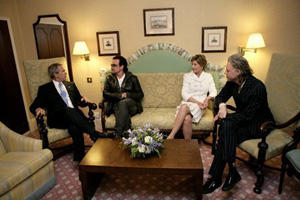
What Are These People Saying?


GW: So Bono, my wife thinks your hair is hot. I'm thinkin' bout getting me one of those rock n roll hairdews. What's your opinion?

Bono: The hair will work if you get the sunglasses too....

Bob G: It's exactly what you need Mr. President to get your ratings up with the young people.

Laura: I agree, and plus you'd be really hot!

GW: Then it's settled! Laura, have Dick call my barber and tell him that I want one of 'dem there Bono hair cuts.

Bono: But Mr. President, what are we going to do about all the poverty in Africa and the third world?

GW: This reminds me of an ole' sayin that my grandpa used to say on the farm.... "if the beans don't bite then it's time to burn the bacon."

Bono: Huh?

GW: Don't mess with Texas!! Ye yeah!

What do you think they are saying in the picture? Post your ideas here on the "Beliefnet" website, or just leave a comment at my blog.

Tuesday, July 05, 2005

Youth Pastor and the Summertime = BUSY!!!


Well so far it's been a wild Summer. I've been horrible about neglecting the blog- but if you know the life of a youth pastor then you probably know that this is THE BUSIEST season of the year!!! I've had every intention to sit and write lately, but catching my breath seems to be more important at this point.

Mt. TOP was great- and I did journal about it my experience every day which will be my next several posts.

This week Jen and I are on holiday at St. George Island, FL. It is absolutely georgious. I'm really sorry that I haven't been blogging lately, but between reading for my summer grad class and youth stuff- there's not much time. I'll write when I can. I HAVE BEEN READING all the blogs that I subscribe to (you know who you are- well most of you do).

Later all,
Jonathon

Thursday, June 16, 2005

Monasticism- MT. TOP Style


Sunday I'll be heading to Mt. TOP for our Youth Summer Mission Trip/Pilgrimage. I'm pretty excited. While staying in the Cumberland mountains where we'll be doing home repair, yard work and whatever God throws our way. I'm always frazzled the week before a trip like this but once I get there I"m definitely in my element.

This year I'm taking a book along with me to use as a devotion time- A RETREAT WITH THOMAS MERTON by M. Basil Pennington. I'm seeing the setup of Mt. TOP- a rustic camp, community of people living a shared and common life together, set times of worship/prayer, community, meals, etc... and times of work/service to neighbor, and play- as a monastic adventure. Mt. TOP as an organization does not see itself this way, but there is a remarkable resemblance to monastic community and structure and the structure of a mission trip such as this.

So next week I'll be away, but keep me and my youth in prayers as we head to East TN to take time out to be a lil' bit monastic.

Sunday, June 12, 2005

My Theological Type- You Guessed It- J.W.!!!


You scored as Evangelical Holiness/Wesleyan. You are an evangelical in the Wesleyan tradition. You believe that God's grace enables you to choose to believe in him, even though you yourself are totally depraved. The gift of the Holy Spirit gives you assurance of your salvation, and he also enables you to live the life of obedience to which God has called us. You are influenced heavly by John Wesley and the Methodists.

Evangelical Holiness/Wesleyan


79%

Neo orthodox


75%

Emergent/Postmodern


64%

Roman Catholic


64%

Classical Liberal


61%

Charismatic/Pentecostal


36%

Reformed Evangelical


36%

Modern Liberal


32%

Fundamentalist


14%

What's your theological worldview?
created with QuizFarm.com

Friday, June 10, 2005

Baker's Dozen


So while we were at the Emergent Convention last year- Gavin and I really enjoyed sitting in on Jonny Baker's Alt.Worship seminar. Jonny is doing some really cool worship stuff over in the UK at Grace Church.

So in honor of my friend Jonny I composed a song tonight using a Jonny Baker sample. It's called "Baker's Dozen (Video...Music...Whatever)".

You can check it out on the TreeFinger myspace site.

also,
I'm off to Brentwood (just down the road from Nashville) for FRESH- The Tennessee YOUTH Annual Conference. I'm leading two sessions at the conference- Discerning your spiritual gifts- which will be for the entire group, and then I'll be leading a small group on Social Activism. The cool thing is that as we end, we'll be overlapping with our Annual Conference. It should be a good weekend.

shalom,
jonathon

Thursday, June 02, 2005

New TreeFinger Track


I just posted 2 new tracks from my newest musical adventure- TreeFinger. You can visit the myspace site and listen or download the tracks right here: Homeward Bound, Blessed are the Peacmakers, Making Space, Trainwreck in the New City.